Thursday, April 30, 2020

Stonehenge, & Other British Mysteries

Stonehenge: 

and Other British Mysteries


The video, "Stonehenge, etc" is a short intro to the ancient phenomena of stoneworks: standing stones, stone circles, stone rows and such that you may find all over Europe. In fact you may find such things all over the world — the pyramids of Egypt and Mexico, for instance, would fit my definition. Shapes, circles and debris that have some sort of cultural significance, yet now perhaps exist in a ruined form. I mention Stonehenge in particular because most can relate to it, have heard of it, even if they don't know what it is, exactly. Turns out nobody knows what it is exactly. The Cerne Abbas Giant is less secretive; it is quite obviously something to do with fertility. We present you with a remote circle of 19 boulders in Torhouse, Galloway, Scotland and some white horses on Wiltshire hillsides. The horses are related to the Cerne Giant in Dorset, a remnant that broadcasts its meaning far and wide. You needn't go far from the giant before you discover somebody whose life has been forever altered by association. 
Anyway, here's just a sampling, enough for us to have followed up the travel film, "It's Great! Britain" with one called "Etched in Stone: Scotland to Provence" which draws more attention to the stone artifacts strewn across centuries of civilization since the Stone Age. There's plenty more where this stuff came from, and we'll be getting to lots of it yet. I think it's the Celtic blood.


Saturday, April 4, 2020

Song: Would You Fly? (Bonnie & Clyde Song)


The song, "Would You Fly" was the first of our Louisiana songs. 


For Marsha, I wrote "We found ourselves in Louisiana/ We had been searching many years/ Now our lives are intermingled/ It's like music to our ears." 
It seems a little bit appropriate for Bonnie and Clyde, who treated Louisiana as a safe zone until . . . that fateful day in 1934.

The song was very lucky for us. We put it on the flip side of "Cajun Christmas" (when people made records and they had flip sides) and it somehow made its way to the Off-Broadway play, "Steel Magnolias." Then both songs got into the movie: "Would You Fly" is very unobtrusive, some gentle bluegrass music from a radio under a car. "Cajun Christmas" makes a grand entrance when Julia Roberts flips a switch at Dolly Parton's hairdressing salon. "Down in Louisiana we have a Cajun Christmas, etc." 

Marsha & Monty, Children's Stage at the
Red River Revel, Shreveport.
 We were lucky with musicians, too. We had befriended the "Watkins Family" band at various concerts and festivals — Luke and Gene and their kids — and I played their LP on the radio. They laid down the accompaniment for "Would You Fly'" 

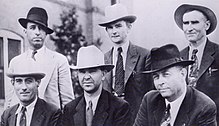
The lives of Bonnie and Clyde ended abruptly on May 23rd, 1934. They were driving south on Route 154 near Mt. Lebanon, Louisiana, when a team of lawmen shot the hell out of their stolen Ford V-8 which they had purloined in Kansas City, Missouri. The lawmen included a former Texas Ranger, Frank Hamer, and three Texas State policemen; plus the local Bienville Parish Sheriff Henderson Jordan and one of his deputies. It was a classic ambush: Bonnie and Clyde were betrayed by a gang member so that the lawmen waited in the bushes and opened fire when they drove into range.
Bonnie at a happier moment.


The car after the shooting.


The car, along with the bullet-riddled bodies of the outlaw couple and a stash of arms and ammunition they'd assembled, was taken to the nearby town of Arcadia. A large crowd gathered during the day. 

The bodies were taken to Conger's Funeral Home which doubled as a furniture store which also sold records to go with their console radios (pieces of furniture). Conger's had connections, via Bienville's own Grigg Family Band, to the Victor Recording Company over the past few years. The Griggs had auditioned for record producer Ralph Peer at Conger's in Arcadia, and their records were a popular item at the store. 
Lawmen responsible for gunning down Bonnie & Clyde.
Front row C, Henderson Jordan, R, Frank Hamer.
 

Thursday, April 2, 2020

Song: Dancing Cajun


It's biographical: the story of our love for Cajun culture told through "Grandpa" from somewhere up north. He loves Cajun music and moves to near Lafayette, Louisiana The song "Allons à Lafayette" is a Cajun Classic and many songs in the Cajun repertoire feature town names in their titles. For instance "Eunice Two-step," and "Crowley Waltz;" Other songs are named for musicians linked to them, like "Bee's Blues" and "One-Step d'Amedée."
There are lots of references to Cajun Life in the video — the Liberty Theater in Eunice and its Friday night shows; Marc Savoy's Music store and his Saturday jams; Fred's in Mamou where there's a party every Saturday morning; the ghost of the Blue Goose. This song is dedicated to all Cajuns. The song begins with a "country" feel but gradually segues into full on Cajun. The fiddler was the late great Rufus Thibodeaux and the accordionist was Gene Savoie. Charlie Moore plays steel guitar. Scott Ardoin production & electric guitar; Eston Bellow, drums on sound and video.

Wednesday, March 11, 2020

Athabasca.

                       ATHABASCA
I moved to Athabasca, Alberta, at the end of June, 1957. Athabasca is a small town about ninety miles north of Edmonton in northern Alberta. It has a big river (the Athabasca) flowing past, but it's a good distance from Lake Athabasca: about 350 miles if you wanted to float there. The river is the longest in Alberta and the lake is large but most of it is in Saskatchewan.

I had just graduated from University School, a private boarding school in Victoria, B.C. I'd been going to that school, as a boarder, for the past seven years, (since the age of nine,) while my father, a single parent, had been working as the Cariboo regional Medical Health Officer for the British Columbia government in Prince George.

This is a lot of information for someone unfamiliar with my world to take in, I know, but just stay with me. I was sixteen years old and had never been to a public school, never been to school with girls, had a brother, Peter (3 and 1/2 years older), but never had friends outside of my boarding school. I was planning on going to the University of B.C. in Vancouver that September.

My father, dressed for the weather in Prince George.

We drove from Prince George, in central British Columbia, to Athabasca soon after I arrived "home" from boarding school. I wrote "home" that way because for nine months each year  the school was my home: my bedroom shared with seven or eight others; my living room quite communal and the kitchen and dining room was the domain of a professional chef.

Athabasca represented a continuation of the Prince George experience. I expected to spend most of my summer solo, since I didn't know anybody and was shy of going out and meeting new people.

However, my life was changed completely when John Richel turned up at the front door of my dad's rented house. I had been in Athabasca for a few days, my dad was probably at work, and I could have been reading a book. I did that quite a lot.

Suddenly here was this force of nature at the door, telling me who I was, asking me if I'd like to jump in his delivery van (he had a part-time job as delivery boy for a local grocer) and immediately threatening to take me over. In a nice way. John was blond, wore glasses, was  about 6 feet tall, strongly built and  slightly bow-legged. He had a ready smile and a charming lack of shyness. His father, a big man named Nestor, later played bridge regularly with my father. His mother was warm and friendly, a perfect example for me who'd never had a mother at all.

House party at Doc Wrights. Town kids.
I soon began meeting the Town kids. There weren't that many of the right age in a town with a poulation of 1200. In fact, 1200 sounds like a large number compared to the actual number of Town Kids. Then there were the Country kids, from the surrounding farm community who aren't available until school starts in September. This was early July.

The teenagers loved the rock'n'roll set: it was the heyday of Elvis, Chuck Berry, Little Richard, Fats Domino and Jerry Lee Lewis. I had just come from an urban environment and was familiar with Buddy Holly's "That'll Be the Day," which the country bumpkins had never heard of. In those days certain places heard pop music ahead of other places, a concept which would be hard to conceive of in the 21st century. Anyway, I actually taught the band to play "That'll Be the Day," and this gave me a certain je ne sais quoi. At the time I had not learned to play guitar, so this was quite an achievement for me and for the bandleader's son, whose name I have forgotten.


As for names of the kids in the above photo, which is the only picture I have from my year in Athabasca: on the left. half of a person names Cremer. Next, the guy with a white car coat, is the youngest Fix brother. His father Charlie Fix owned a service station in town. I believe this was Junior Fix. He had older brothers, Alan and Don.

Now for the gals: In the rear, leaning backwards, I believe is Sandy's (John
Richel's steady) younger sister; perhaps Jane. On the sofa, rear right, Cathy Philipzyk and Patricia, last name not coming to me. And in the foreground, Erin Wright, adopted daughter on Dr. Wright, town doctor who owned a DeSoto and also had a son Jamie who we called Doc. Erin was my girlfriend sometimes. I think she had issues, perhaps traceable to being adopted. (shrug).  


Sunday, February 9, 2020

Christmas in England

I'd been wanting to do Christmas in England for many years now. The Christmas I'm thinking of was probably invented in New England — Dickens, Rudolph, Angels  roasting, figgy pudding, 12 days, 3 Kings, and a partridge in a pear tree: that Christmas.


I think we did it once before, in 1996 or thereabouts. 
I know we did Christmas in France, in 1994; they called it "Nöel" which seemed impolite. But that was France: Chateau Bidaine in Provence: far too "Mediterranean" to have much to do with Frosty the Snowman or the birth of Christ in a creche. Of course I spent the first Christmas in England — no, not that one, I mean mine: Tickhill, nr. Doncaster, Yorkshire pudding, World War II. Then from 1941 through 1946 (the War, cont.), and again from 1963 through 1970. But enough statistics, lets talk about the present.

We arrived in London on the morning of the day: Christmas 2019. Traveling on Virgin Atlantic, we got upgraded to first class; a wonderful present as we were able to sip champagne and then totter into a horizontal position when we were ready. It certainly ruins you for Economy. At the beginning of the flight, perhaps pre-take-off even, the chief steward rambled scratchily on the PA system (why, if they can launch a huge airplane into the ether, can they not install a PA system that sounds intelligible?) about some act of charity and how the crew would like to return the favor and do somebody a good deed in return so they asked anybody who was born in 1940 or before to speak up and make themselves known.

I waved my arm and the stewardess I had spoken to as I came on board came over and squatted by my seat. I told her I'd been born in 1940 and after we kibitzed for a moment, she disappeared. A few moments later the head steward, whose name was Billy, came and squatted in the aisle beside my seat and it was then I became aware that something truly momentous was about to happen. Billy and one or two stewardesses — they were all costumed in a manner befitting the occasion (Christmas Eve, remember) then began to gather our coats and luggage and with a Heigh-Ho, Ho Follow, Follow, they led us into the realm of the first-class passengers. 

From that moment on it didn't even feel like we were inside an airplane. Marsha had sometimes described the feeling (in Economy) as traveling inside a tuna can and it's hard to deny that. But this, now, felt like being back on dry land, as it were. You could move around without expecting to fall down, bump your head and slither underneath a seat. 

In fact there is nowhere inside a large contemporary passenger plane that should give the impression of spaciousness, but the contrast between the classes is so great and the champagne in your hand so meritorious, that you immediately feel like a million bucks, in a place immune to things like airplane crashes. Everything is much more permanent in First Class. In the words of the immortal Hank Williams, "there'll be no teardrops tonight."

We arrived at London Heathrow — LHR to you frequent flyers — at around 7 a.m. and were to be met by my daughter, Justine, and her husband Hugh who live in Balham just three or four railway stops from Victoria Station. It was here that the trouble first began.

Since we fly to Europe and spend some months there nearly every year, we have duplicates of our musical equipment and a plenteous wardrobe. But all our stuff is at the Chateau Pruniers in the middle of France. And we are staying a week in London and then flying on RyanAir, an airline noted for being very stingy with their customers' luggage allowance. Of course you can carry as much luggage as you want on the brief hop from Stanstead (London) across the Channel to Poitiers in mid-France. But doing so makes a mockery of the original reason for getting tickets on RyanAir:the price!

To further complicate the matter, since I have no guitar in England, yet plenty at home in Louisiana, I decided to bring one with me. I could leave it with Justine and she, who is coming out as a singer, could have an instrument to practice on for at least the 11 months I am not there. It's a Takamine Classical very much like the one I leave in France. I packed it in the sturdy case that was specially built for my handmade (by Ron) Louisiana swamp guitar. The case looks like a small coffin and is virtually indestructible. The airline baggage handlers will not harm this baby!

Alas! The guitar doesn't even arrive. The revenge of the baggage handlers. We wait futilely until the gondola, or whatever they call it, has practically squeaked itself to death and then I have to report the situation to the proper desk. Luckily it's going to be pretty easy to spot if it hasn't been stolen. The case is unique. 

The woman behind the counter has a very positive attitude. If she thinks my case is hopeless (pun?), she certainly doesn't let on. "They will deliver the guitar to your London address (Balham) when they locate it. Probably tomorrow," she says.

I thank her and hope for the best, though I can't help thinking I may never see it again because the baggage mis-handlers threw it up in the air and crashed to the tarmac in several pieces, or it took a detour to Mali and was purloined by a young Malian airport worker.

We finally head for the exit and quickly find Hugh and Justine. We tell them the sad story of the errant Takamine and almost forget the heartwarming tale of the First Class upgrade. Something similar had happened to them, recently; nice for them, we think, but it cheapens our own good fortune slightly. Not really. I was just looking for a good turn of phrase.

Their car is small. A mini, in fact. It couldn't get much smaller unless it was a Smart car, but we managed to cram ourselves in there for the ride back to their house. We took the Westway to Hammersmith and the Circular past Wandsworth Common. Because of Christmas there was very little traffic on the road. In a way it was fortunate that the guitar was somewhere in Africa.

The plan was to move in to our bedroom in Balham, take a nap, then cross London to Highgate where my sister Fiona was preparing Christmas dinner with her partner, Benn, an Irishman she has been seeing for a couple of years.

By the way, when Benn and Fiona first met, he mentioned that he had a house in France where he spent most of his down time. I don't know the details of the conversation but at some point Fiona must have asked him "Whereabouts in France?" to which he would have replied,"Oh, you wouldn't know it, it's a small town in the middle of France." (A pause here, perhaps, while he decides whether to tell her more of this obscure yet picturesque destination.) "It's a little place called Montmorillon," he adds.

Now it so happens that Montmorillon is home to, or rather, three kilometers south of, the Chateau Pruniers, which Fiona is quite familiar with and always welcome at. What an amazing coincidence! It looks like we'll be seeing a lot more of them.

The fifth member of our family entourage, George Anderson, was asleep in one of the small, first floor bedrooms at 93 Ravenslea, which has been Hugh's London (Balham) home since back in the 1990's. George is the younger son of my cousin Robert Anderson who is the same age as me; or one month older. They are a soldierly pair. Robert had a career in the British Army, working his way up to chief Psychologist. He peaked during the time of the Gulf Wars. George has turned his less-than-stellar career in the same Army into physical education instruction which he is doing in the wide open spaces of the London parks. I'm not quite sure how it works but George advertises himself as a personal trainer or a group instructor. He is in good shape.

George is quite large so he is offered the front seat; Marsha, Justine and I will share the back seat along with overnight bags and piles of "pressies." We may have been crowded on the way from the airport, but we could not have taken on the guitar for this phase of the trip crosstown to Highgate Village.

On the move again, and again not so much traffic on this Christmas Day. Christmas party withFiona and Benn, Gemma and Tiger, Marsha and me, George, champagne, turkey, brandy butter, brussels sprouts, etc. The movie and huge TV, "Four Weddings and a Funeral." George talked quite a lot, a clear indication that he had been over-served. 

We slept in the tiny microwave apartment which is a perfectly decent sized bedroom, and a perfectly fine little bathroom (shower, toilet and basin), with a microwave in between and a door out to the balcony. Fine for a day or a few, or as a pied-à-terre. The weather was sunny and clear all Christmas Day, we did photos on the big balcony, and it drearied up on Boxing Day.

Boxing Day we get up late and go back to south London to Justine and Hugh's. During the following days we spend a lot of time around the house which we are good at these days. When we first started traveling extensively we used our time differently: when we were visiting Europe we packed as much activity as possible into each waking hour; now we treat each day as though we were at home, which is Louisiana at the moment.

That may also be a function of old age.

One evening we met Fiona and Benn at the Royal Academy (The Art museum on Piccadilly) to see a show which featured the self-portraits of Lucien Freud, a grandson of Sigmund who lived in London most, if not all. his life. A refugee from Hitler's pogroms.
Fortnum's all lit up for Xmas.
Afterwards we met Justine, who had been working at her English teaching, at Fortnum and Mason's for a glass of wine. And then to 45,Jermyn Street, the restaurant next door. This was perhaps the most expensive restaurant I've ever been to, and the food was pretty good, the atmosphere very high class and fun.


We are basically doing public transport, now, as it would be silly to use the little car. So it's either the underground at Balham Station/Northern Line (half a mile - 9 minutes walk) or the Southern RR system at Wandsworth Common (.2 of a mile - 5 minutes.) There is also a Rail Station at Balham, but . . . The railway takes one to Victoria Station which offers a whole new palate of destinations, including a tube to the Tate Britain.

One day Hugh and I took this route to the Tate to see William Blake's show.
 

We met Justine there. Marsha wasn't feeling well so she stayed at the house.


We all left London together to go to the New Years' party at "the chateau" in Montmorillon. Fiona and Benn were taking the train — the Chunnel, Paris and Poitiers. We were flying to Poitiers Airport via London Stanstead. This is the Ryanair route and it is a cheap jump ( 10, 15 quid each maybe) but baggage is restricted and it costs about 10 or 15 quid to get the train from Wandsworth Common vis Victoria. 

    
Hugh and Ivan.

To be continued. We spent the next week in France and the following one in New York City. We flew back home to Shreveport on January 14th.


Thursday, December 19, 2019