JESSE THOMAS at home on Abbie Street in Shreveport.
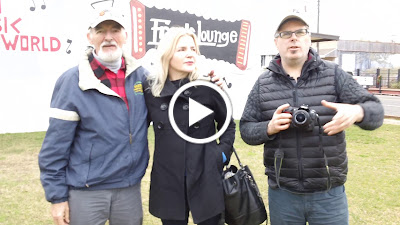
With Monty & Marsha Brown. 1989. Precise date unknown.
[We were talking about working on the farm, in the fields, and how you raised all your own food and that sort of thing.]
We stayed in the country in the middle of a big field with trees all around.
[Did your family own the land?]
No. He (Jesse’s father) was working for somebody else. It wasn’t a big plantation farm like it was in other places, like on Red River, places in Georgia, Mississippi where you have a big plantation or a whole lot of families on it. Just one family, small farm.
[Was the land owned by white people?]
Yes. It was mostly white people.
[Which of your brothers played music?]
All of them except the baby boy — there was one younger than me. That was the baby boy and he didn’t play. And the girls didn’t play. Two of them could play a few sounds on the guitar, but they didn’t fool with it because they didn’t hardly like girls to do things like that in the country in those days. The boys could do it, and the boys worked outside in the fields, in the woods, in construction, anything outside. The girls did mostly the home work, like milking cows, cooking, washing. They would also work in the field too, but they had to do home work, you know, work around the house, but not he guitar. They had a tradition, like, some of whatever you might call it, cause if you wasn’t playing gospel song, they wasn’t particular about you playing music too much. We had to slip (sneak) around mostly when we were learning. We had to work, we couldn’t sit around playing music. Now on the weekend, if we didn’t go to church Sunday, well, we’d get out into the yard by ourself and practice on the guitar. But if you wanted to just take it up, be a musician, some of them say, “The devil gonna get you,” and things like that.
[The devil gonna get you for playing music?]
Yeah, that’s what we had to come up, under that kind of stuff. We had to slip around. I didn’t ever think there would be any such thing as that you could make a living playing music. We didn’t know that. Until I left home. First left Logansport and went to Texas to live with my older brother and go to school one year and I came back I was 15 years old and that’s when I ran away from home and came to Shreveport. See we went to Logansport one Saturday, shopping, and I heard an electric piano (player piano) playing, and it was a newer tune, a newer music from what we had been hearing. See we had been playing the same thing so long we were just about fed up with it, listening to it, didn’t care for it, and I heard a piano playing a new song, and it was playing a melody and harmony and bass patterns, and it sounded so good and so much better than what we had been hearing. That’s when I wanted to be a piano player. So, I started practicing on different people‘s pianos, trying to play piano, just fell in love with the piano, started trying to be a piano-player, but I was never able to own one so I got back on guitar. I started back playing guitar but I did take piano lessons when I was in Fort Worth but that was when I was about 19 years old, started taking piano lessons and I come to read music that way.
[Was it your older brother who gave you the idea you could make a living at music?]
Well in 1926, Willard — you know the one called Ramblin’ Thomas? — he left home. He had learned how to play with the slide-type and he went off and made money playing and like that, and came back the next year and that did give me an idea that you could make money playing, but I still wanted to be a piano player, and when I came to Shreveport (1926) I thought about, you know, trying to play for money, but I didn’t know enough about it, didn’t have enough experience, and I couldn’t sing too good, and I didn’t know any songs, but that got me started. When I was in West Texas working on these farms out there, close to Dallas where we were and I could go to Dallas, then I saw the professional guitar players making a living, making records, and then my brother got on record after he went out there. He made — for Paramount Records when he made a session they would pay $200 for a session. That was a lot of money in those days. And that really did make me wanna get on record. Then I saw Lonnie Johnson, guitar player, and he was famous at that time, had a lot of hit records out , and that really encouraged me to take up guitar and I copied some of his stuff (“Careless Love”). And I was starting to make a little money. I would work some and play some, and it wasn’t very long, a couple of years later, I started playing altogether. There wasn’t so many songs out there then. You didn’t have to play so many songs like you did now.
[Did you write any songs back then?]
Well I didn’t “write” em but I just made up songs like when I got on record in 1929 — “Blue Goose Blues”- I just made that up, you know, and went in the studio, and . . . .
Blue Goose?
That’s a little place here in Shreveport, or a little area they used to call the Blue Goose, it’s down on Snow Street and Pickett. You remember where the Union railway station used to be? You wasn’t here when those trains was coming in.
[No.]
Well anyways a part of town used to be -
[I know where Snow Street is, sure. Over near the I-20.]
Well that was just the name of that area. Like Mooretown, South Highland, Blue Goose, that’s what it was. So I just thought of that coz that’s where I stayed when I first came here — Cedar Grove, Blue Goose, and I just, made up some words, put it on record.
Blue Goose is the area up there where the old baseball stadium is, up through there?
No. Where the Union railroad station was, along there somewhere. Union Station used to be on Louisiana, going down, just after you runs into Highland, no, after you runs into Howell.
[Oh, I know where you’re talking about, OK. You’re talking about down there — there’s still the station. The station’s still there, right?]
I think they tore it down.
[What’s the one they turned into an arts center, or —]
Is that what it is? Well, it might be there. On Louisiana?
[Yes.]
Well, see on up a little piece from there was a little area where all those shotgun houses is in there.
[And that’s Blue Goose?]
Uh-huh. Course you wouldn’t have the I-20 there then, too. Pickett Street runs into it. Snow Street too, I think, runs on down, Howell Street goes on up, along down in there.
[That’s a good song.]
Think so? [Laughs] I didn’t even know what I was talking about. [Laughter] I guess that sometime makes the song. I’ll sure play it if you think it’d do me anything. I would do that. I got some different words. Have to remember the words.
[Jesse picks up his acoustic guitar and plays “Blue Goose Blues” instrumentally and then sings:]
“I’m going down to old Blue Goose, got no time to lose.”
[Finishes and laughs.]
Got to play it to get the words down. The music still sounds alright.
[Is that your tune, too, out of your head?]
That’s right. I don’t know how I made that, I think I saw some old man and he was real good on the guitar, on the chords, and he didn’t sing that good, just play something like that, and I copied some of that and put the words to it. And Blind Blake used to have something kinda in that style. [Plays] He would play in that style and I thought he was a real good guitar player. Nice chords. Played finger style. [Plays some more]
Family
It was 13 born in our family but it was 9 of us that were raised. 4 of the kids died when they were babies, and that left 6 boys and 3 girls. I was the twelfth child. Had one more younger than me. As they got grown they would leave. The older one, he got married - he was married when I was born (1911), rest of them, they got grown, they would leave if they had to. The older brothers would always keep an old guitar round the house.
[There was more than one guitar around the house?]
Sometimes, but there would always be one, some of the older brothers would have one.
[Tell me about your (brother) — Ramblin’ Thomas — what happened to him?]
Well, after he made records he stayed in Dallas a while, he went to Houston, went, see they used to when they made records on Paramount they would send people to Chicago, and he went on his own to Chicago and stayed awhile. Then he left Chicago and went to Memphis, Memphis, Tennessee, and that’s where he got sick and died. In 1937 he died in Memphis.
[So you weren’t with him? What’d he get sick of, do you know?]
Well he used to — fast life, I think, was his problem.
[He was a few years older than you. What, ten years?]
Nine years. That could’ve been it. He drank a lot.
[He played slide guitar, didn’t he?]
Yeah, with the bottle, you know, some of them uses that little (bottle neck on a finger.) And he mostly played that. He did some finger-picking also, but he mostly played slide.
[With the guitar flat?]
Yes, he would hold it flat across his lap. Most guitar players in those days, they played by themselves and sang, coz we didn’t know music in a way to play in groups and how to keep time, so we didn’t have any special tempo or time. Most guitar players played by themselves.
[Did you play with him ever? On a record, or —]
Not very much, and not on record. It was so much different than what I played. We played parties together, things like that, but we didn’t play too much together because I was studying music, and keeping up with the songs coming out, and he was just playing his regular tunes that he recorded. I played different things. Type of things he played, he played blues and I was trying to play a variety type of music.
[He must have had quite a following for a while there.]
He did. When he first started out, and when he first got on record, he was hot, I would say, he was hot at that time. Records sold good — course he used — he was his whole orchestra on those records — I believe if he had kinda straightened up and wrote some new tunes, and been more businesslike, I believe he could have made it big. But he got to drinking so heavily. He had a lot of fans and a lot of girlfriends, and he just went down. I used to tell him, I said, I would slow down, get you a light job, you know, work some, you know, when you wasn’t making the records, write some new songs. They was going so good, and enjoying so the way he was going and it ran out. Then he got sick. I tried to go see him when he was in Memphis but I got to Pine Bluff, and stayed there two-three weeks, playing around there in Arkansas and I thought he had moved away so I didn’t go on into Memphis. I never did see him.
[How did you find out he’d died?]
Well the people he were living with, they wrote to my parents and told them about it. Said that he’d started home, tried to come home, but he was too sick to come home,
Traveling.
Lot of it was hitch-hiking, I didn’t have any trouble catching rides, you know,around to different places. You had the acoustic box and the driver would see it and if they’d hear you playing, they’d just pick you up, give you a ride. “Where are you going, where do you wanna go?” Sometimes they’d pay you, give you a little money to play for them while they were driving in the car. One man would buy me food, give me a little money, you’d play, sometimes they’d have drinks, buy you drinks.
I didn’t have a bit of trouble catching rides, but a lot of times I rode the bus. Greyhound bus. And when I’d get on the bus I’d play music on the bus, they’d pay me. It went on like that for a while. Then jukeboxes came in.
[Did you ever have anything set up? Like if you went to Pine Bluff did you ever have a job to go to or did you just go there and start to play?]
That’s the way it was, I’d just go there.
[You didn’t have any tours set up?]
No [laughs] I didn’t even know what that was. I was touring the country, but I didn’t know it. Just going from place to place.
[What about Willard? Did they arrange anything for him?]
No, but he didn’t go from town to town as much as I did, he would get in a city and stay there. If he went to Chicago, he’d stay there. When I was in Fort Worth, he stayed there. In Memphis he stayed, but I would go from town to town. Like if I were in Houston I’d get on the road going to San Antone and stop at every town along that route. Coz I was hitch-hiking I couldn’t buy a ticket all the way to San Antone I would go as far as I could that day and if people see you’re going to be in town they give you work to do and I’d play a day or so there. But one day, you get up the next morning and you’re back on the highway. You stop at a little town the same thing.
[That’d be a neat thing to do.]
Don’t try that type of traveling (now), it was alright back in them days, but people are different now, they didn’t mind giving you a ride back then. I remember one time I was going to San Antone, I think it was in Gonzales, Texas, one Saturday, Saturday night, I played around there all day and a group of people wanted me to stay there, a bunch of girls, they asked the boys whether they pay me a little something, [mimics young girl’s voice] “You’re gonna stay, you gonna play for our party, you play for our party,” but I didn’t know that type of business, you know, staying and playing for parties, work a town when it was, I stayed that night, got up early next morning, but I forgot all about that party — I didn’t know a thing about business and I wasn’t trying to make money on the road, I was just trying to get from one place to another.
Recording.
I went to San Antone because I heard they was making records. A friend of mine told me that the Okeh Record Company was in San Antone recording people — the companies used to come down South and make records with those portable machines, carry em back, press em — and I got on the highway and hitch-hiked to get on record, but I got there too late. They were finishing up when I got there and I missed getting on record. They had a lot of people they had put on record. One of the guys that I met there was Little Hat Jones and a band that recorded was Boots and his Buddies. So I missed the recording session. The reason I wouldn’t stop in those towns where I could’ve got a job playing was because I wanted to get to San Antone before the record people left town. I didn’t get on in San Antone and they said this same company gonna be making records in Dallas, Texas, week after next. And I got back on the road again, going back to Houston, I was staying in Houston, going back to Houston to get my suitcase and clothes. Then I hitchhiked to Dallas to try to get on again. And I went up to audition, they were recording in some hotel there in Dallas and that’s when I met Forty-Nine, this guy that put me in with the Victor Company. He was up there among those people that was recording for Okeh, and he heard me playing round and I had heard of him before when I was in Dallas before, and I met him again at that session and he told me, he said, “Victor going to be coming to Dallas next, and you can get on record with me and Bessie Tucker.” Well, I wanted to go to Kansas City — lot of things happening in Kansas City — so I got as far as Oklahoma City and I stayed there for a while and I got in touch with Forty-Nine, told him I was in Oklahoma City and when the Victor Company came he had em sent me a ticket and I went back. And that was in 1929 and I got on the Victor record.
[That’s when you went back to Dallas, from Oklahoma City?]
Yeah and that’s when I made it (onto record).
[How’d they get in touch with you?]
They sent a telegram when they sent for me, a telegram and a ticket.
[Did they send a bus ticket?]
Railroad ticket. Trains. There was more trains traveling then, passenger trains. More than buses.
[So you came down to Dallas by the train. What happened after that?]
And then we recorded for RCA Victor and I played some on Bessie Tucker’s records and I went back to Oklahoma City after that.
[Can you describe what it was like at the recording session? How many people were there and how you got to record your own tunes?]
It wasn’t too many people there when we were recording. I know they had a microphone for me to play and sing through, one mic, and they were in another room recording, but it wasn’t a big studio like they have now, all those tracks. I don’t know what kind of equipment they really had but I know it wasn’t big like studios we have now. But I was in one room with the microphone singing and playing, and they would have been in another room, recording. And it wasn’t tape. You probably know more about what they were using in those days and what the master would be on, and they would take that back to New Jersey, or wherever their factory was and press the records.
[Do you remember the man who was in charge of the session?]
His name was Ralph Peer. He was with RCA records at that time. Ralph Peer.
[Did you talk to him very much?]
No. They just told him about me and he listened to me play and he put me on record and give me a contract and paid us for the session. No he didn’t talk too much.
[What year was that?]
That was in the year 1929. I was 18 years old at the time.
[Who else were they recording at that time?]
In the studio when I recorded was a lady named Bessie Tucker, she was singing blues, and a piano player named, — we called Forty-Nine, — and on the record that she made she also had a bass player. It wasn’t a big bass fiddle, wasn’t a bass guitar, it was a bass horn that they used on there and I don’t know whether she had a drum or not, seemed like she had a couple of more guys playing on her record and I also played the guitar.
[Was she pretty popular at the time?]
Yeah. She had made records before and they were selling pretty good.
[She played mostly around Dallas, right?]
Yeah. She did some touring. I think they went to Denver and a few places around and in the country and put on shows.
[She travel with Forty-Nine?]
Yeah, they traveled together.
[Were they recording black musicians and white, like country and big bands and everybody, or were they just really interested in black musicians at that time?]
At that particular session that they were doing on us, that were just for blues, but he would have other sessions for — Jimmie Rodgers was there in the studio at the time that I recorded, but I don’t know whether he recorded after we left or what, but I don’t remember him making any recordings while we were there, but he probably recorded after we left.
[Were you there all day?]
Yeah - a couple of days.
[Were you familiar with Jimmie Rodgers at the time or was he somebody that you’d not heard of?]
I was familiar with his music coz I’d heard a lot of his records. He was real popular for the type of music he was playing. He was doing a lot of yodeling and he was the first one I heard doing that type of thing. Yodeling and playing that type of music.
[And you said you saw Lonnie Johnson while you were in Dallas. What was that like?]
When I first came to Dallas I saw Lonnie Johnson. He was at the theater doing a vaudeville show, playing popular music and blues, songs like “My Blue Heaven” and “So Tired” and what popular songs was out at that time. They didn’t come out fast like they coming out now, they’d have about two or three new songs would come out in a year’s time. And I saw how famous he was and making money and had clothes and that started me to wanna be on record too and make money.
[What kind of money were you getting to be on a record back then?]
Paramount Records paid $200 for a session at that time and I guess there were others might have paid it up until the time that I got on record. The business had fallen off and the Depression was coming and I think we made about $50 a session or something like that. $25 a song, and like that, for the Victor recording. Paramount also paid 3 to 5 cent royalties. They made money on a record in those days. $200 a session was also like we get now, they almost paid as much then for a session as they do now. Now different artists get different advance for it.
[After you recorded in Dallas, what then?]
I went back to Oklahoma City trying to get to Kansas City, and I went back out on the farm in Altus, Oklahoma, picking cotton, [this would be November 1929] and that was when I missed them —
[Victor?]
Yeah, they came back that fall, that was in the summer when I made the records, I think about July, but they came back about October, November, but they couldn’t find me — I was out there (in Oklahoma) and nobody knew where I was. I never did record for them again. But if you get on record in those days, you could make money.
Was there a time when you felt like you were living high, you were like a well-paid musician?
No I never did really reach that stage at that time. It was pretty rough for me. I would make a little money here and there, and have fun here and there, but I never did really feel independent with a steady income because it wasn’t regular, whatever I was doing it didn’t bring in a regular income.
[Could you count on people to take you home and feed you, put you up for the night, that sort of thing?]
Yeah, in some cases if I go to a strange town and I didn’t know anybody, people hear me play, people were real nice about things like that, they say, “Where you from? Where you stay? You got you a room?” The people would accommodate me.
[You talk about going to San Antonio, Fort Worth — like, how about racially? Like you got Spanish people —]
When I first got to San Antonio, I had never seen no Mexican people before, and I didn’t know where I was, but they look just like other people, you know, they say, “Come on pardner, can you play the guitar?” and I started playing around a bunch of them, and one guy says, “Play me some blues, I like the blues,” and I played what I knew, and they gave me a little money, and I told them I didn’t know where I was, I was lost, and one said, “Come on pardner, I’ll show you where the colored people is,” and he walked with me all the way back, across town, wherever it was over in the black area. And that was that. And the same with the other towns. Sometimes I get into town, didn’t know where the colored folks were, met somebody, “What part of town you come from?” But like if I get into town on a Saturday, where the town be just full of everybody, you meet a colored boy, “Oh you just come into town, where you stay? Man you stay up at our house. Come down here to Miss So-and-So’s Cafe.” They’d give you a place to stay, I didn’t have a bit of trouble getting a place to stay, and food, stuff like that, but I couldn’t make no money. Coz there wasn’t too much money in circulation, and that was bad. But I was touring, just like an artist touring and making one night stands. But I didn’t even know that. I didn’t even know that was a part of the business. If I’d kept that up, and known what I was doing and had almost a business way, could’ve had something like a manager or booking agent I would’ve made out pretty good with somebody advertising me, telling the people that I was playing what was on the record, which was what those stars were doing, could’ve made a little crowd and made some little dances and parties in those towns. They really did like what I was doing, were kinda wild for music in those days, they really did enjoy it and they would make me welcome, and they wasn’t too used to all types of music like it is now, you know, radio, TV, stereo and all that, television, movies.
Material
We get it from other people, what we hear other musicians doing, what we see them doing, we would just copy some of it and play it. Some of the musicians would make up little songs of their own, but we mostly played what we see other people playing because the music was quite different and we would mostly play among ourselves and have fun. We wasn’t trying to be too much different because we wasn’t thinking about making a living at the music — it wasn’t too many guitar players making money. We would mostly play for fun, because we had talent and because we could play. When we get together we would just play and have a good time. Until we did start to make a little money and started getting on records, we played mostly free. Until that happened. And there wasn’t no such thing as a person, when he’d start picking a guitar or playing music, they wasn’t thinking bout Big Times, coz there wasn’t too much of that anyway.
[But you did go out of your way to get recorded, didn’t you?]
Oh yeah, after I went to Dallas and saw famous guys like Lonnie Johnson and Blind Lemon Jefferson making money, then I got interested in making money. Up until then I didn’t know you could make a living playing music. And that’s when I started out on the road and went to traveling, going from place to place. And then I went to playing for money here and there, but if you could if I didn’t have a room, didn’t have any money when I came, I say, “No. I just got in town.” I would be trying to play, They would say, “C’mon with me, you can stay up where I’m going to, let em hear you play, they’ll get you a room, you can stay with me,” then I always would work on the side, if I could get a job. In those days, jobs were pretty scarce too and a lot of work wasn’t by machinery or driving cars like now, the work was harder, kinda hard work and some of it I couldn’t even do, like construction work I couldn’t do it because it was mostly manual labor and hand work and heavy lifting and stuff like that.
California
So I played around, still played and got a little group and we started traveling west and went to West Texas and on into Arizona, finally wind up in California.
[So you went out to California with a group?]
Yes.
[And played as you went?]
Oh yeah.
[Then you ended up in Los Angeles? Is that where you went to first in California?]
Well, when we first got to California we stopped in those little towns fore we got to Los Angeles — El Centro and Indio and places like that, and we mostly stayed in Los Angeles when I first went there, then after that I went on traveling through the state of California, different towns.
[When you first got there you were actually a band, and you stayed together as a band there? How many pieces in the band and what were they?]
It was first four of us and then one of the guys left and we had a trio then, there were three of us. I worked a long time with the trio. Two guitars and something like a snare drum, mostly singing and playing.
[Who were the people you played with?]
Oh, Carl Douglas was one - the guitar player — Preston Hass was the drummer and we all sang.
[Where did they come from?]
They were from Texas. I got with them in Texas. You played the latest tunes, we worked where we could.
[Did you ever have a chance to get into movies?]
That was quite a few years later when they were making the movie “Gone With the Wind.” We were supposed to be in that movie and when we went down to the studio they asked for our union card and since we was not in the union they turned us around at the gate.
[That was the closest you came?]
Yes. One time we were supposed to make a movie with Rochester — “A Man About Town,” I think was the name of that movie — we didn’t get to get in that either.
[Was that because of the union again?]
No, they didn’t say what it was. They didn’t call us back.
[Are you talking about the band?]
It was all of us in the band, but I don’t know whether we was going to be playing music or what we were going to be doing. We didn’t know — they didn’t explain to us what we would be doing. They were using a lot of people for the movies at that time, they getting ready to make a movie, so different people told us that we might have a chance to get in
before they sent for me.
[There were several years between the time you recorded and the time you went to California. How did you make a living during those five or six years?]
I would still play around where if I could get a little money.
[You recorded in 1929, but the next time was years later - what? Twenty years later? Where was that?]
That was after I went to California and got on small labels in LA like Swing Time records, later I got on Modern records, Modern label, and a small label that was owned by Roy Milton and later I went to Specialty records, and then I think it was around in the ‘50s —40’s, late ‘40’s, early ‘50’s, I made a lot of records in Los Angeles. Also, I had a label of my own called Club records. I made some songs on my own label and didn’t have any distributors or connections and they didn’t do anything.
[Where was Club?]
That was in California. See I had moved around playing celebrations and rodeos and things in California and I stayed in a town called Salinas ‘bout, oh I’d say about seven years. But I would go to LA and San Francisco the whole time I was in California, wherever I was playing, it didn’t matter what town I was in I would usually visit the cities.
[So Club records was when you were in Salinas?]
Yeah. I made two songs on my own label, but they didn’t do anything.
[You met some famous people in California, too, didn’t you?]
Oh yeah, in Los Angeles I met Nat King Cole (1919-65), T-Bone Walker (1910-75), Les Haight, and comedians like Mantan Moreland (1902-73) and Rochester — used to be with Jack Benny — he had a night club, and we played for him in his night club and different groups around there - Oscar Moore (1916-81), he played guitar with Nat King Cole. Met quite a few musicians there in Los Angeles.
[Did you make records after you came back to Shreveport?]
No — I think I cut some tapes here in Shreveport but I didn’t get on any label. I just had a few records pressed but I didn’t send them to any distributors.
[Do you have any left?]
No I haven’t kept any of those old records. They were 78s.
Miltone, 1948. Club, 1948. Freedom (Houston) 1949. Modern, 1949. Swing Time, 1951. Hollywood, 1951. Speciality, 1951. Elko, 1953. Hollywood (Shreveport) 1958.